How Google Search Works: Inside the Algorithm
 (9).png)
Every day, billions of people type questions, keywords, and phrases into Google. From “best pizza near me” to “quantum computing basics,” Google processes over 8.5 billion searches per day. But have you ever wondered what really happens between the moment you press "Enter" and the instant Google presents a ranked list of results?
Behind the simple search bar lies one of the most complex technologies ever built. Understanding how Google Search works is not only fascinating but also essential for businesses, marketers, and anyone looking to make their content discoverable online.
In this article, we will break down the process step by step, covering crawling, indexing, ranking, and serving, while also exploring the algorithms and signals that make Google Search so powerful.
The Core Functions of Google Search
Google’s search system is built on three fundamental pillars:
- Crawling which is the discovery of content across the web.
- Indexing which is the organisation and storage of that content.
- Ranking and Serving which is the decision of what to show and in what order.
Each stage is powered by advanced computing, artificial intelligence, and constant algorithmic updates.
Crawling: Discovering the Web
The internet is constantly growing. New websites appear, pages are updated, and old content disappears. To keep track of this ever-changing ecosystem, Google uses web crawlers, often called Googlebots.
How Crawling Works
Googlebot begins with a list of known URLs and sitemaps submitted by website owners. It then follows links on these pages to discover new content. Each time it encounters a page, it retrieves the HTML and records important elements such as headings, text, images, metadata, and links.
 (1200 x 500 px).jpg)
Technical Details
- Crawl budget refers to how many pages Googlebot chooses to crawl on a given site. This depends on factors such as site authority, structure, and server health.
- robots.txt is a file that allows or blocks Googlebot from accessing certain pages.
- Crawl frequency varies. Popular and frequently updated sites are crawled far more often than small or static ones.
In essence, crawling is discovery. But discovery alone is not enough. Google needs to understand and store the data. That is where indexing comes in.
Indexing: Building Google’s Library
If crawling is discovery, indexing is organisation. Think of it as a library catalog system.
When Googlebot crawls a page, the content is processed and added to Google’s index, which is a massive database containing trillions of web pages.
 (1200 x 500 px) (1).jpg)
Key Steps in Indexing
- Google parses the content, analysing text, images, video, and metadata.
- It applies canonicalisation to determine the main version of duplicate or similar pages.
- Through Natural Language Processing (NLP), Google interprets context, synonyms, and intent.
- It stores signals such as keywords, freshness, relevance, and relationships between pages.
Advanced Indexing Features
Structured data such as schema markup helps Google understand specific content types like products, recipes, or events.
Mobile-first indexing ensures Google primarily uses the mobile version of content for ranking and indexing.
Media indexing goes beyond text to include images, video, and even audio, often using AI-driven recognition.
At this stage, your page is “in the library.” But not all indexed pages appear in search results. That decision is made during ranking.
Ranking: Deciding What You See
Once you type a query, Google must sift through its massive index and decide which pages are most useful. This happens in a fraction of a second and is powered by hundreds of algorithms and ranking signals.
Ranking Factors
While Google does not reveal every ranking signal, confirmed factors include:
- Relevance, which measures how closely a page matches the query’s intent.
- Content quality, which looks at accuracy, authority, and depth.
- Backlinks, which act as endorsements from other trusted sites.
- User experience, which includes page speed, mobile friendliness, and usability.
- Freshness, which ensures timely results for news and trends.
- Location and personalisation, which tailor results based on region, language, and search history.
AI and Machine Learning in Ranking
- RankBrain helps interpret queries and match them with relevant results.
- BERT and MUM are language models that understand context and meaning beyond keywords.
- Helpful Content Updates prioritise human-first content over keyword stuffing.
The result is a ranked list of results tailored to your intent, device, and context.
The Search Results Page (SERP)
The Search Engine Results Page is no longer just a list of ten blue links. Depending on your query, you might see:
- Featured Snippets, which provide direct answers at the top.
- Knowledge Panels, which summarise facts about entities such as companies or places.
- AI Overviews, which are generated summaries of information.
- Local Packs, which show businesses on a map.
- News, Images, and Videos, which provide multimedia responses.
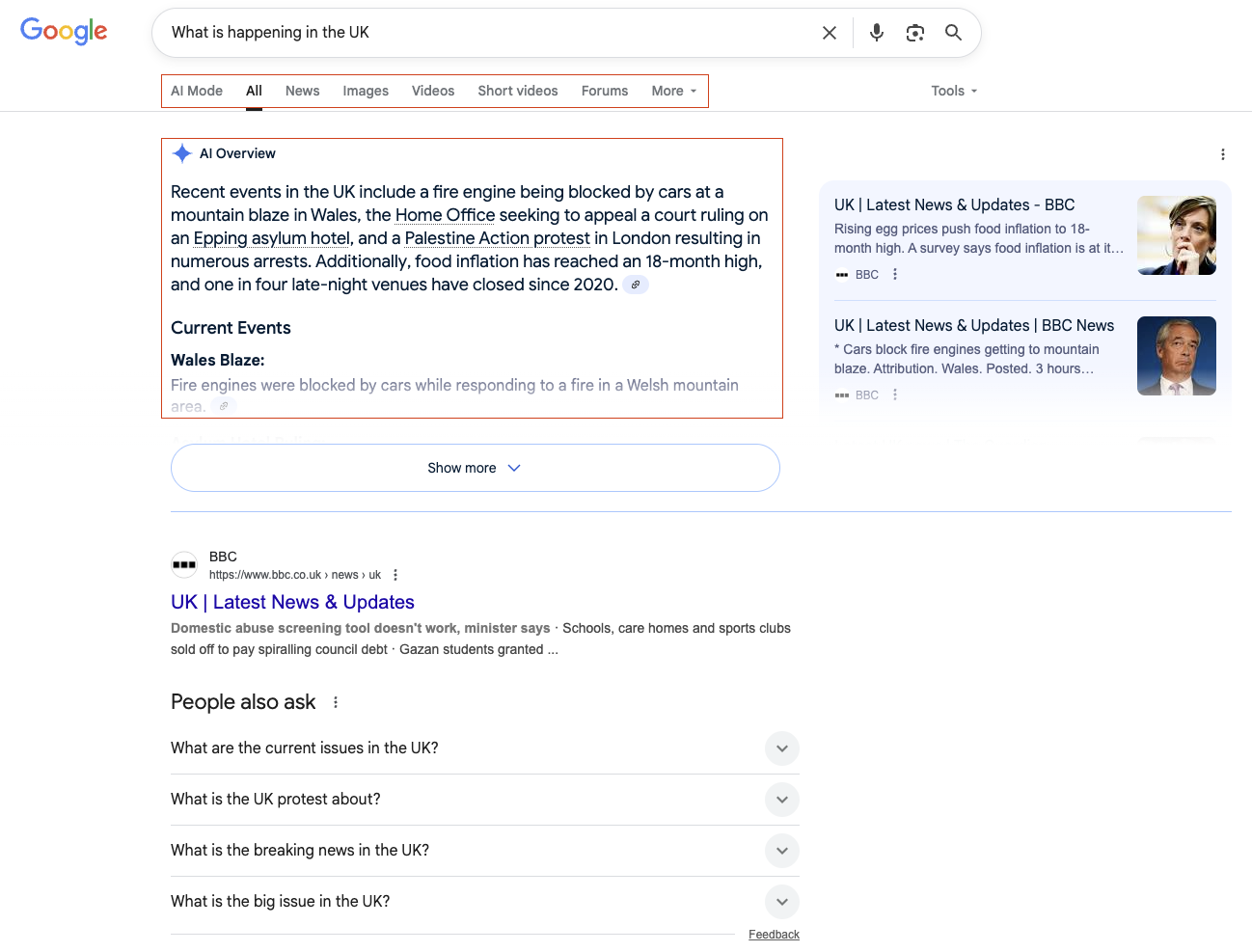
Each SERP feature is chosen based on query type and what Google believes would be most useful.
How Google Keeps Improving Search
Google constantly refines its system. The company makes thousands of algorithm updates every year, ranging from minor adjustments to major updates such as Panda, Penguin, and Helpful Content.
Key Priorities in Google’s Evolution
- Fighting spam by detecting low-quality or manipulative content.
- Understanding intent rather than relying on keyword matching.
- Prioritising speed and usability for all devices.
- Elevating trust and authority by rewarding fact-checked and reliable content.
These improvements ensure that users get accurate, useful, and safe results.
Why This Matters for Businesses and SEO
For businesses, understanding how Google Search works is fundamental. Visibility, traffic, and revenue often depend on it.
The key takeaways are simple:
- Keep your website technically healthy so it is crawlable and indexable.
- Publish accurate, comprehensive, and helpful resources.
- Earn backlinks and build authority in your niche.
- Prioritise people over algorithms by focusing on user-first optimisation.
Success in search is not about shortcuts. It is about aligning with how Google genuinely works.
📊 Reader Poll: Share Your Insight
We are curious to know what you think. Join the poll and tell us.
Conclusion
Google Search is a marvel of modern computing. It discovers, processes, and ranks an unimaginable amount of information in milliseconds.
From crawling new pages to serving personalised results, the process is highly technical yet entirely focused on users.
For businesses and creators, the key lesson is clear. Focus on producing high-quality, relevant, and user-first content that aligns with Google’s mission of organising the world’s information and making it universally accessible and useful.
The next time you search, pause for a moment to appreciate the complexity behind that simple white page. It is not just a search. It is one of the most advanced systems ever built, designed to bring the world’s knowledge to your fingertips.


Adxom is a global SEO and link-building platform
trusted by startups, agencies, and brands to grow
rankings with fast, reliable, hassle-free results.
