Is Quantum SEO the Future of Ranking on Google?
 (13).png)
The Changing Search Landscape
Quantum SEO is not science fiction. It is a practical mindset for the era of reasoning engines and generative results.
The core idea is simple. Search is moving from static indexes toward systems that reason with live data. If ranking now depends on what an AI can find, verify, and synthesize at the moment of the query, then the winners will be the sites that are easiest for these systems to discover, evaluate, and use.
Why Classical SEO is No Longer Enough
Since Google began rolling out AI Overviews in May 2024, several independent analyses have found that clicks on classic organic listings fall when an overview appears.
Search Engine Land reported materially lower click through rates for informational queries. Digital Content Next observed that the average click through rate for the top result on overview keywords dropped from 7.3 percent in March 2024 to 2.6 percent in March 2025.
The signal is clear. Being the best blue link is no longer enough. Your content must be the source the AI chooses to quote, cite, and ground on.
By the numbers:
- Ahrefs: Position 1 CTR dropped 34.5% when AI Overviews were present (analysis of 300,000 keywords).
- Amsive: Average 15.49% CTR decline across 700,000 keywords, with losses up to -37.04% when AI Overviews combined with featured snippets.
- Non-branded keywords: AI Overviews are most likely to appear here. Amsive saw a -19.98% CTR decline, while Ahrefs found 99.2% overlap with informational intent.
- Lower positions hit hardest: Keywords outside the Top 3 saw a -27.04% CTR drop (Amsive).
- Branded queries are safer: Only 4.79% trigger AI Overviews, but when they do, CTR actually rose +18.68%, likely due to higher user intent and recognition.
These numbers confirm what SEOs are already feeling: AI Overviews don’t just skim clicks; they redistribute visibility, often away from organic results that were previously performing well.
Quantum SEO vs Traditional SEO: A Quick Comparison
.jpg)
Quantum Thinking and Search Algorithms
Quantum algorithms model uncertainty natively and search through possibilities in ways that differ from classical step by step logic.
Grover’s algorithm can find a marked item in an unsorted set in roughly the square root of the number of items rather than scanning the entire set.
That principle matters for SEO. If your content is richly connected by entities, claims, and citations, it becomes a stronger candidate for selection when an AI system explores a large space under uncertainty.
Early Experiments with Quantum PageRank
Researchers have created versions of PageRank that use quantum walks. These approaches can reduce degeneracy and highlight more nuanced hubs in complex networks.
While still academic, they point to a future where high quality link graphs matter more than ever. Authority built on authentic references becomes more visible as ranking methods evolve. Instead of a random surfer moving through links step by step, a quantum walker can explore many paths simultaneously thanks to superposition.
One study demonstrated that Quantum PageRank distributes importance scores more evenly across a network, reducing cases where many nodes tie for the same rank.
This helps highlight subtle hubs of authority that the classical algorithm might overlook. In tests on small-scale networks, quantum versions produced rankings that were more stable and less sensitive to dangling nodes (pages with no outbound links).
While these experiments were performed in controlled simulations rather than on the open web, they show how quantum-inspired methods could one day refine the way authority and relevance are measured. For SEO, that implies a future where link structures are evaluated with far more nuance than today’s algorithms allow.
Hardware Reality and Practical Lessons
Full scale fault tolerant quantum computers are not here yet, but that should not hold back SEO strategy.
Many benefits will arrive through quantum inspired methods rather than pure quantum execution. For marketers, that means you do not need a quantum processor to act like a quantum thinker. You can shape content and site architecture today to be the easiest target for retrieval and reasoning.
What Quantum SEO Looks Like in Practice
Quantum SEO treats your website as a structured knowledge source rather than a set of pages. It maximises the probability that an AI system will select your information during real time grounding.
It accepts that many queries will end with a synthesised answer and still finds a path to value by ensuring your facts, explanations, and examples are the ones the model relies on.
Although Quantum SEO is still a speculative field, here’s how it might function:
- Quantum Algorithms scan massive datasets (user intent, search patterns, click behavior) in milliseconds.
- Generative AI dynamically creates and updates website content in response to new queries and ranking signals.
- Neural SEO models predict which content structures and formats perform best in specific user contexts.
- Quantum Link Mapping determines the most efficient link structure for crawling and authority distribution.
Ultimately, Quantum SEO is about making your content future-proof. As AI Overviews, chatbots, and copilots continue to dominate the search experience, the websites that succeed will be those designed not just for humans to read, but for machines to interpret, cite, and trust in real time.
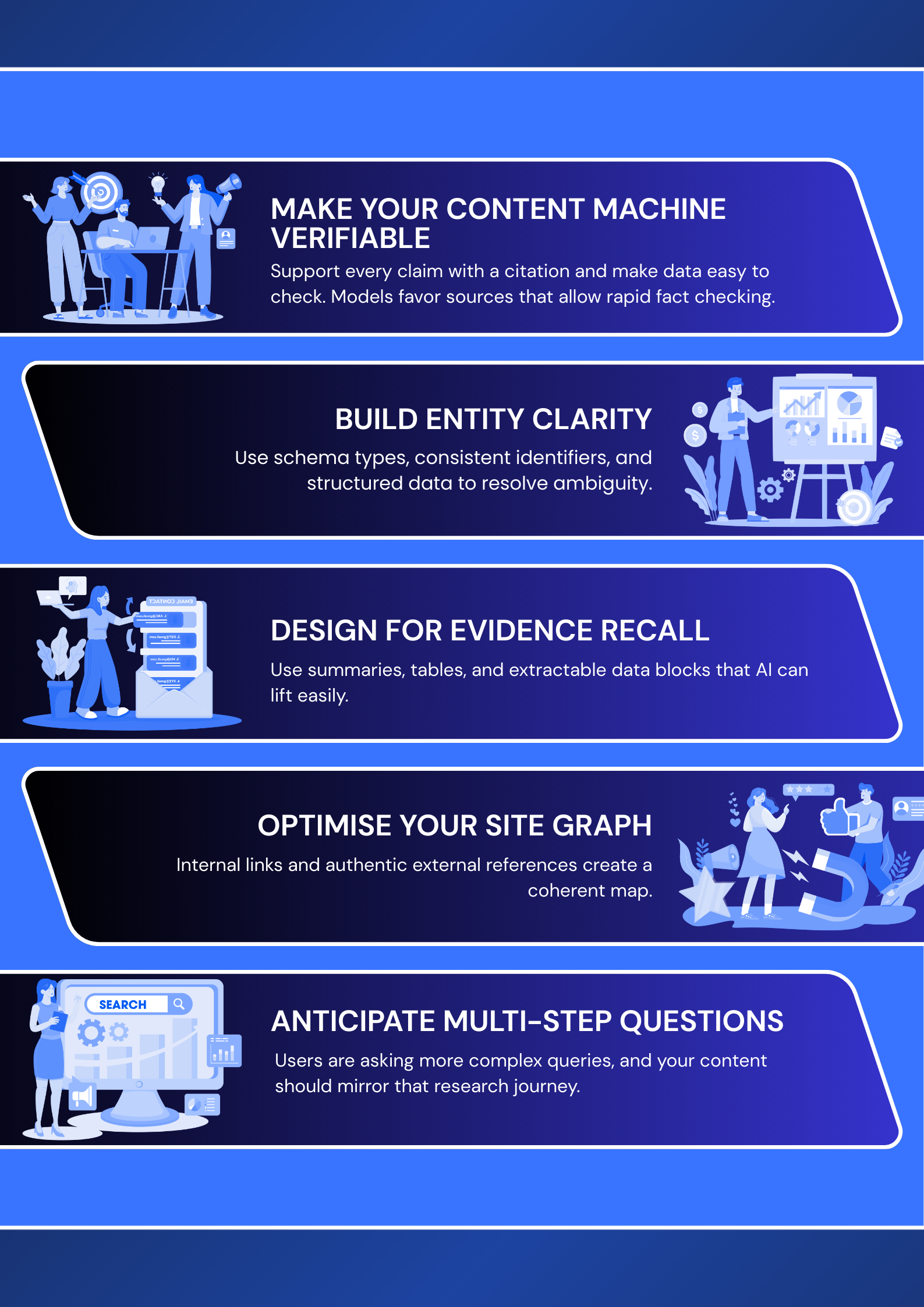
The Five Pillars of Quantum SEO
Evidence of a Real Shift
We do not yet have hard proof that quantum algorithms run rankings in production. What we do have is evidence that reasoning over retrieval is here to stay. AI Overviews already reduce clicks, and the winners are brands whose content earns citations in synthesised answers.
My Opinion: Why I Am Pro Quantum SEO
Quantum SEO is not a gimmick. It is the strategic layer under every content program. Success will be measured not just by keyword positions but by inclusion rates inside AI answers across assistants, overviews, and enterprise copilots.
Editorial planning must lean into original data, expert quotes, and reproducible methods. Link building must focus on meaningful connections rather than volume.
Taking Action Today
If you are ready to adapt, start with a content audit for verifiability, entity clarity, extractability, and graph quality.
Add structured data, consolidate thin content, create data assets, and review site architecture. Then track not only traffic and rankings but also AI citations.
Conclusion
Is Quantum SEO the future of ranking on Google. I believe so. Models will keep evolving. Presentation of results will keep changing.
The principles remain stable. Make the truth easy to find, easy to verify, and easy to reuse in real time. Do that consistently and you will remain visible in the age of AI search.


Adxom is a global SEO and link-building platform
trusted by startups, agencies, and brands to grow
rankings with fast, reliable, hassle-free results.
