What Changed in Google’s December 2025 Core Update
 (77).png)
Google rolled out the December 2025 core update over 18 days, starting December 11 and completing December 29, according to Google’s Search Status Dashboard. This was the third confirmed core update of 2025, following March and June, and Google categorised it as an “incident affecting ranking,” which is consistent with how it communicates broad, system level changes.
Google, as usual, did not provide a detailed changelog. What we do have is (1) the timeline, (2) the patterns reported across verticals by credible analysts, and (3) Google’s own evolving stance on how quickly improvements can be reflected even outside major updates. Put together, the December update looks less like a brand new direction and more like a sharper enforcement of trends that have been building all year: specialisation, direct authority, and intent matching.
Timeline and confirmation
Google confirmed the launch at 9:25 a.m. Pacific on December 11, with a stated rollout window of up to three weeks. The dashboard later confirmed completion on December 29. Search Engine Land reported the same start and end dates, noting the rollout took a bit over 18 days.
SISTRIX analysed SERP movements over the past 90 days using daily updated data. The analysis is based on mobile search results in the United Kingdom, providing a clear view of visibility trends and ranking changes during this period.
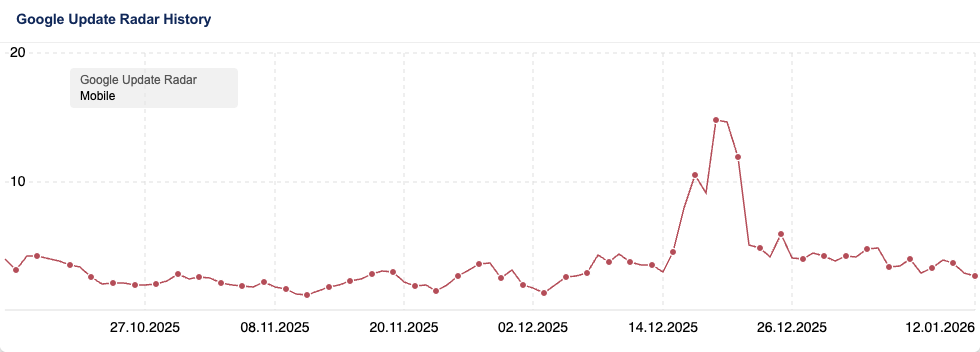
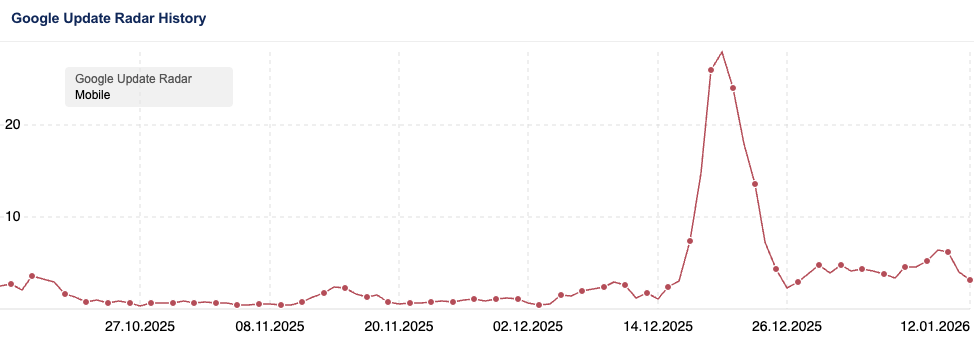
For the United States, the trend follows a similar pattern, with SISTRIX tracking SERP movements over the past 90 days using daily updated data based on mobile search results in the US.
What actually moved in the wild
An increase in the amount of changes in the SERPs was first seen in data from the 14th to the 15th and has continued to develop strongly since then.
Winners and losers appear across reference, informative and ecommerce sites. The table below shows a selection of domains that have shifted in significant percentage or absolute values, up and down.
 (1).png)
Source: SISTRIX
Big Reference and Trust brands Gained
- thesaurus.com: 228.44 to 283.99, up 24.32%
- trustpilot.com: 81.22 to 112.68, up 38.73%
- oxfordlearnersdictionaries.com: 116.74 to 142.73, up 22.26%
This supports the broader theme: when Google is recalibrating quality and satisfaction signals, it often lifts brands that users consistently recognise, return to, and trust.
Apparel and retail specialists surged
- shein.co.uk: 10.28 to 22.62, up 120.04%
- boohoo.com: 14.78 to 23.91, up 61.73%
- prettylittlething.com: 26.79 to 35.77, up 33.51%
- riverisland.com: 25.60 to 35.32, up 37.98
These are not thin affiliate publishers. They are direct retailers with strong commercial intent alignment, brand signals, and product depth.
One of the biggest percentage movers
- vinted.co.uk: 1.97 to 9.59, up 386.81%
A jump of that size suggests Google reweighed how it evaluates certain marketplace style results for relevant commercial queries, at least in the UK.
The sharp edge of December: YMYL and news volatility
If you want a grounded operator’s view, Glenn Gabe’s post is one of the most concrete and experience driven analyses in circulation. He reported heavy impact in YMYL categories, calling out finance first, then health and medical, with “massive volatility” across well known sites. He also flagged major news publishers seeing heavy impact and dropping out of Discover, which aligns with what many news orgs felt in real time.
Separately, Datafunc documented how many publishers saw Discover and Google News traffic drop sharply after the Dec 11 to 12 rollout, including cases where visibility that had been stable for years collapsed within 48 hours. Their framing is important: even if your content did not change, Google can re-evaluate systems and re-allocate visibility fast, especially on time sensitive surfaces.
Put bluntly: if your business depends on Discover, you are operating with platform risk. December 2025 made that risk impossible to ignore.
So what did Google likely change?
Google does not publish the internal mechanics of a core update. But we can triangulate based on the patterns above and on what Google itself emphasised: “relevant, satisfying content.”
Here are the most defensible interpretations, plus informed speculation.
1. Stronger “entity legitimacy” weighting
SISTRIX’s winners list includes major trusted brands and recognised destinations like Trustpilot, Oxford Learner’s Dictionaries, and large retailers. That pattern is consistent with Google leaning harder on brand and entity level trust signals: is this a known authority for this query type, and do users behave like it is?
2. More aggressive intent matching for commercial and mid funnel queries
Retail and marketplace growth in SISTRIX’s UK set points toward stronger alignment with transactional intent, where direct sellers or strong category destinations are rewarded.
Google may be classifying more queries as shopping adjacent, then ranking fewer publisher style list pages and more direct category authorities. This is not a moral judgment. It is simply how Google maximises satisfaction and reduces “pogo sticking” on commercial queries.
3. YMYL re scoring got sharper and faster
Glenn Gabe’s observed volatility in finance and health, including large swings for authoritative players, suggests quality thresholds and trust reassessment became more sensitive.
This fits what we have seen historically: in YMYL, Google would rather be conservative and reshuffle aggressively than risk ranking something it later considers insufficiently trustworthy.
4. Discover and News became more fragile under core re-evaluation
Datafunc’s reporting on sudden Discover and News drops implies that the update affected more than classic “ten blue links.” Glenn Gabe’s mention of publishers dropping out of Discover reinforces that.
Google likely adjusted how it predicts satisfaction and engagement on news surfaces, then quickly re-distributed impressions away from outlets that no longer met those predictions.
What winners did right, based on observable signals
Across the domain examples, you can infer common traits:
- Clear topic to brand fit (dictionary sites answer language queries, retailers satisfy shopping intent)
- Strong user familiarity and repeat usage (brand recognition)
- Depth where it matters (product inventory, reviews, taxonomy, internal linking)
- Lower “middleman” feel on transactional queries (users can complete the intent faster)
This does not mean small sites cannot win. It means small sites have to win by being the clearest specialist in a narrow lane, not by trying to out publish or out generalise a massive brand.
What to do now: practical triage for 2026
- Segment impact by intent type. Separate informational, commercial, and YMYL pages. Core updates rarely hit everything evenly.
- Audit your “reason to exist” for each query set. If you are a publisher trying to rank for product queries without unique testing, data, or expertise, you are competing with brands that December 2025 appears to have favored.
- Treat Discover as bonus, not baseline. If Discover traffic is mission critical, build a plan that assumes volatility and invests in stable channels too.
- For YMYL, increase clarity and evidence. Strengthen author credibility, citations, editorial standards, and update discipline. YMYL is where Google appears to swing hardest.
- Track changes with dates and restraint. Use the Dec 11 to Dec 29 window as your benchmark, and avoid changing ten things at once while you diagnose.
The bottom line
December 2025 did not introduce a brand new Google. It revealed Google with less patience.
The domains that gained tend to be recognisable authorities and direct intent satisfiers, as shown clearly in SISTRIX’s UK movement table. The sites that lost hardest were often in YMYL or news ecosystems where trust and distribution can be re evaluated quickly, as Glenn Gabe and Datafunc both describe.
For 2026, the safest strategy is not “more content.” It is sharper specialisation, stronger proof,


Adxom is a global SEO and link-building platform
trusted by startups, agencies, and brands to grow
rankings with fast, reliable, hassle-free results.
