Agentic AI Optimization: How to Make Websites Ready for AI
 (31).jpg)
Why Agentic AI Optimization Matters Now
Artificial intelligence is changing how people search, compare, and interact with digital content. Search is no longer limited to users typing keywords into Google and clicking through results. AI assistants, conversational search tools, and autonomous AI agents are beginning to interpret information, compare options, and make recommendations on behalf of users. That shift creates a new challenge for websites. It is no longer enough to optimize only for human readers or traditional search crawlers. Websites also need to be clear, structured, trustworthy, and actionable for AI agents.
This is where Agentic AI Optimization, also called AAIO, becomes important. While traditional SEO focuses on search visibility and user intent, Agentic AI Optimization focuses on making websites easier for AI agents to understand, evaluate, and act on. The goal is simple: if an AI agent is helping a user compare services, choose a provider, book an appointment, request a quote, or make a purchase, your website should provide the right signals clearly enough to be considered.
What Is Agentic AI Optimization?
Agentic AI Optimization is the process of preparing websites, content, and digital experiences for autonomous AI agents. These agents do not browse websites the same way humans do. They scan, interpret, compare, and act based on structured information, trust signals, clarity, and task readiness.
In simple terms, AAIO helps a website become more understandable and useful to AI systems that may recommend, summarize, compare, or complete actions for users. A website optimized for AI agents should clearly explain what it offers, who it serves, how pricing works, what actions users can take, and why the information should be trusted.
This includes strong content structure, schema markup, transparent business details, clear service descriptions, reviews, FAQs, and machine-readable signals. Agentic AI Optimization does not replace SEO. It extends SEO into a world where AI agents play a larger role in search, discovery, and decision-making.
What Are Autonomous AI Agents?
Autonomous AI agents are AI-driven systems that can perform tasks with limited human input. Instead of only answering a question, they can interpret a request, gather information, compare options, make decisions, and take action. For example, an AI agent may help a user compare service providers, shortlist products, plan a trip, book a reservation, or recommend a tool based on specific requirements.
This changes how websites are evaluated. A human user may read several pages, compare layouts, and make a judgment based on design, tone, and trust. An AI agent is more likely to extract structured meaning quickly. It looks for clear answers, reliable data, consistent details, and action-ready pathways. For websites, this means the audience is no longer only human. It also includes AI agents acting on behalf of humans.
Why Agentic AI Optimization Matters for SEO
Traditional SEO helps search engines understand and rank content. Agentic AI Optimization goes a step further by helping AI agents understand whether a website is useful, trustworthy, and suitable for a user’s task. This matters because AI search and AI-assisted browsing are changing how users discover information. A user may not visit ten websites manually. Instead, they may ask an AI assistant to compare options and recommend the best one.
If your website is unclear, unstructured, or missing important details, an AI agent may skip it. If your website clearly explains services, pricing, features, policies, reviews, and next steps, it has a better chance of being understood and recommended. AAIO matters because visibility is moving beyond rankings. The new question is not only whether your page ranks, but whether an AI agent can confidently select, cite, summarize, or act on your website.
Core Pillars of Agentic AI Optimization
Agentic AI Optimization depends on making websites easy for AI agents to read, trust, and use. The most important pillars are clarity, structure, trust, and action readiness.
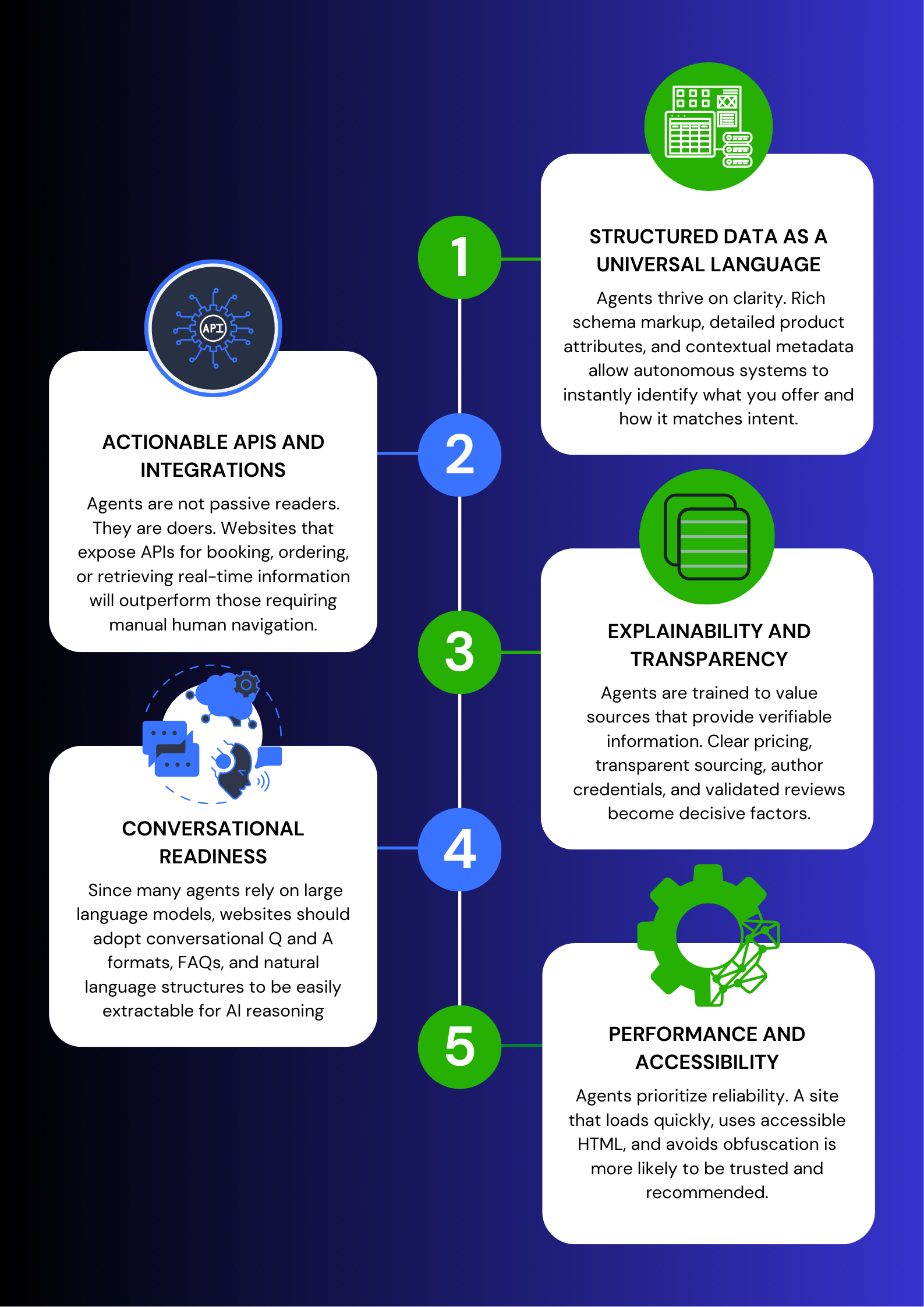
1. Clear Content Structure: AI agents need content that is easy to scan and interpret. Use clear headings, direct answers, short sections, descriptive labels, FAQs, and consistent page structure.
Avoid vague marketing language that sounds impressive but does not explain the offer. AI agents need specific details, such as what the service includes, who it is for, how pricing works, what limitations apply, and what the next step is.
2. Machine-Readable Information: A website should provide information in formats that machines can understand. This includes schema markup, structured data, clean HTML, clear page hierarchy, accurate metadata, internal links, and crawlable content. For service pages, machine-readable information may include service names, locations, pricing ranges, reviews, FAQs, business details, and contact options. For product pages, it may include availability, specifications, reviews, shipping details, and return policies.
3. Strong Trust Signals: AI agents need reasons to trust a website before recommending it. Trust signals include author information, business details, reviews, testimonials, ratings, certifications, case studies, policies, contact information, and transparent claims. Weak or missing trust signals can make a website less useful for AI-driven recommendations, especially when users are comparing providers, products, or services.
4. Action-Ready Pages: An agent-ready website should make the next action clear. If users can book, buy, request a quote, contact support, compare packages, or start a project, those actions should be easy to find and understand. This is especially important for AI agents that may help users complete tasks. Confusing forms, unclear pricing, missing CTAs, or hidden policies can reduce the chance of being selected.
5. Content Built Around Decision-Making: AI agents compare information quickly. Your content should answer the questions that influence decisions. This includes:
- What the service or product is
- who it is for
- What is included
- What is not included
- How pricing works
- How long does delivery take
- What users need to provide
- What makes the provider trustworthy
- What action should the user take next?
The clearer your decision-making information is, the easier it is for AI agents to evaluate your site.
.png)
SEO vs Agentic AI Optimization
SEO and AAIO are connected, but they are not the same. SEO focuses on helping search engines understand, index, and rank pages for user queries. It includes keyword research, content quality, backlinks, internal linking, technical SEO, page experience, and search intent. Agentic AI Optimization focuses on helping AI agents understand, compare, trust, and act on website information. It adds another layer to SEO by preparing content for AI-driven search, conversational answers, recommendations, and automated tasks.
The difference is intent.
SEO asks: Can this page rank and satisfy a searcher?
AAIO asks: Can an AI agent understand this page, trust it, and use it to help a user make a decision or complete a task?
That makes AAIO especially important for businesses that depend on bookings, purchases, service comparisons, quotes, forms, subscriptions, or local discovery.
AAIO Readiness Checklist
Use this checklist to see whether your website is ready for AI agents. Your website is more agent-ready if it has:
- clear page titles and headings
- direct answers to important user questions
- structured service or product information
- schema markup where relevant
- accurate pricing or pricing ranges
- clear CTAs and next steps
- visible contact information
- reviews, testimonials, or trust signals
- transparent policies
- crawlable content
- strong internal linking
- helpful FAQs
- clear comparison information
- fast-loading pages
- accessible forms or booking flows
- consistent business details across pages
If your website lacks these signals, AI agents may struggle to understand what you offer or whether you are the right recommendation for a user.
The Strategic Advantage of Agent-Ready Websites
Agentic AI Optimization gives early adopters an advantage because many websites are still built only for human visitors and traditional search crawlers. As AI agents become more involved in search and decision-making, websites that provide clear, structured, and trustworthy information will be easier for AI systems to interpret.
This advantage is not limited to e-commerce. Service providers, publishers, SaaS companies, educators, healthcare providers, local businesses, marketplaces, and nonprofits can all benefit from becoming more agent-ready.
For example, an AI assistant may recommend a clinic because its services, reviews, pricing guidance, location, and booking process are easy to understand. It may recommend a software provider because the features, integrations, pricing, and use cases are clearly structured. It may cite a publisher because the article is clear, authoritative, and easy to interpret. AAIO helps websites prepare for this next layer of digital visibility.
The Future of SEO and AI Agents
Agentic AI Optimization is not a passing trend. It is part of the wider shift from search engines showing links to AI systems helping users make decisions. Search is becoming more conversational, more personalized, and more action-driven. Users will increasingly expect AI systems to compare options, explain choices, and complete tasks.
That means websites need to move beyond thin pages, vague claims, and unclear user journeys. They need content that is accurate, structured, transparent, and easy for both humans and AI agents to use. The future of SEO will not only be about ranking on a results page. It will also be about being selected by AI systems as a useful, trustworthy, and actionable source.
Final Thought
The rise of autonomous AI agents does not reduce the importance of human audiences. It increases the need for clarity. Agents exist to help people. But in many cases, winning the agent’s trust may be the first step toward winning the human user. Agentic AI Optimization helps websites become readable, trustworthy, and actionable in an AI-driven search environment. In a world where machines can compare choices in seconds, the websites that explain themselves clearly will have the strongest chance of being found, understood, and selected.
Want to learn more about AI and SEO: AI and SEO - What It Means For Organic Search Results


Adxom is a global SEO and link-building platform
trusted by startups, agencies, and brands to grow
rankings with fast, reliable, hassle-free results.
