How to Dominate AI Search: The Ultimate Guide
 (40).png)
AI has changed the way people discover information and products. Search is no longer a set of blue links. It is answers, guidance, and actions synthesised by models that draw from the open web and brand owned data. If you want to win visibility and revenue in this new landscape, you must design for AI systems as much as you design for humans.
This guide gives you a practical playbook to dominate AI search. You will learn how user behaviour is shifting, what AI systems reward, how to structure content and data, and how leading brands are already converting intent inside AI experiences. Real examples and current statistics are included throughout so you can benchmark progress and plan next steps.
Understand the new discovery funnel
Classic search was a three step loop. Users typed a query, skimmed a page of results, then clicked to explore. AI search compresses that loop into a single answer, often with citations and follow on questions. Two shifts matter most.
First, a large share of queries now end without a website click. Independent studies found that nearly 60% of Google searches resulted in zero clicks in 2024, with only about thirty six percent of clicks going to the open web.
Second, commercial discovery starts in new places. Multiple reports show that roughly half of product journeys begin on Amazon, not on traditional search engines.
Your strategy must accept that you will not always earn a click. Instead, aim to be the answer, the source, or the action that AI systems trust.
Know the AI surfaces you must influence
You do not need to influence every emergent tool. Focus on the surfaces that shape real demand today.
Google AI Overviews
These summaries sit above organic listings for a growing share of queries. One analysis of more than ten million keywords found AI Overviews appearing in over 13% of searches by early 2025, and rising.
Conversational engines like Perplexity
Perplexity has scaled quickly, with Financial Times reporting fifteen million monthly active users and hundreds of millions of queries each month alongside large funding rounds to fuel growth.
Retail and marketplace search
Walmart, Amazon, and other marketplaces are weaving generative systems into on site discovery, which redistributes intent upstream from the open web. Walmart has publicly detailed its generative search work and data cleanup efforts across hundreds of millions of product attributes.
Emerging referrals from AI assistants
Similar web data shows referrals from AI platforms to publishers have surged year over year, even if they do not yet offset all declines from traditional search. TechCrunch cited a jump from under one million referrals in early 2024 to more than twenty five million in 2025.
Winning means shaping both what the models say and where they send users when a click does happen.
Become an answer source by design
AI systems reward clarity, authority, and structure. Treat every high value topic like a mini knowledge base that a model can quote.
Own the key questions and variants
Map the key questions across awareness, consideration, and post purchase support. For each, publish a definitive explainer with a clear answer at the top, concise steps, and a short glossary. When AI Overviews appear, they pull from content that resolves a query directly and signals expertise.
Use concise, scannable formatting
Write short paragraphs and sentence case headings. Open with a direct answer before adding context. Include numbered steps and tables where relevant. This layout helps models extract exact statements and helps humans skim in seconds.
Structure your facts
For recurring facts such as specs, features, prices, ingredients, or compatibility, present a canonical table on one stable URL. Keep units consistent and include plain language descriptions. Engines can quote a row, and your page becomes the reference.
Cite sources and show evidence
Where claims depend on research, add a short methodology note and cite third party sources. Models repeatedly reward content with clear attribution when summarising. This is visible in many AI Overviews that choose sources with explicit evidence trails.
Refresh on a schedule
Set a quarterly review for top pages. Update examples, screenshots, and statistics. Freshness is a trust signal as AI systems try to avoid stale or contradictory guidance.
Standardise your data so engines can act
Unstructured prose alone will not win. You need machine readable signals that reinforce what your pages say.
Schema everywhere
Implement Product, Organisation, FAQ, HowTo, and Article schema where relevant. Use consistent identifiers for products and services. Keep names, descriptions, and attributes identical between the schema block and visible content. This harmony reduces model confusion when cross checking facts.
Clean catalogs to reduce contradictions
Retailers like Walmart have spoken publicly about using generative systems to normalise hundreds of millions of product data points. The result is faster and more accurate discovery for both customers and associates. This is a blueprint for brands with complex catalogs.
Build a content graph
Link related resources with clear anchor text. Use hub pages to summarise a topic and spokes to dive deeper. Interlinking clarifies relationships for both crawlers and models.
Publish policies and definitions
Create a public glossary and a policies page for returns, warranties, data use, or certifications. AI systems favor unambiguous statements from first party sources.
Optimise for the no click outcome
In a zero click world, success metrics include brand presence inside the answer, citation share, and follow on actions. Practical moves:
Design quote ready snippets
For each high intent page, add a two to three sentence summary that answers the main query exactly. Use present tense, neutral tone, and include a concrete number or example when possible. SparkToro’s analysis shows more than half of searches end without a click, so appearing as the cited source is critical exposure.
Add portable assets
Provide simple diagrams, decision trees, and tables that engines can reproduce or describe. The clearer your asset, the higher the chance it is selected as a reference in AI summaries.
Instrument impression and assist metrics
Track branded searches plus topic level impressions in Google Search Console. Monitor assisted conversions from unbranded to branded queries over time. When AI Overviews appear more often, click volume can dip even if visibility rises. Semrush found AI Overviews showing in 13% of searches by March 2025 and growing, so your measurement must evolve.
Earn authority through real world usefulness
The fastest way to build authority signals that AI systems trust is to be the place where users actually complete tasks or make decisions.
Create calculators and checkers
Tools such as size finders, dosage calculators, or ROI models generate links and citations from journalists and communities. They also produce structured outputs that models can quote.
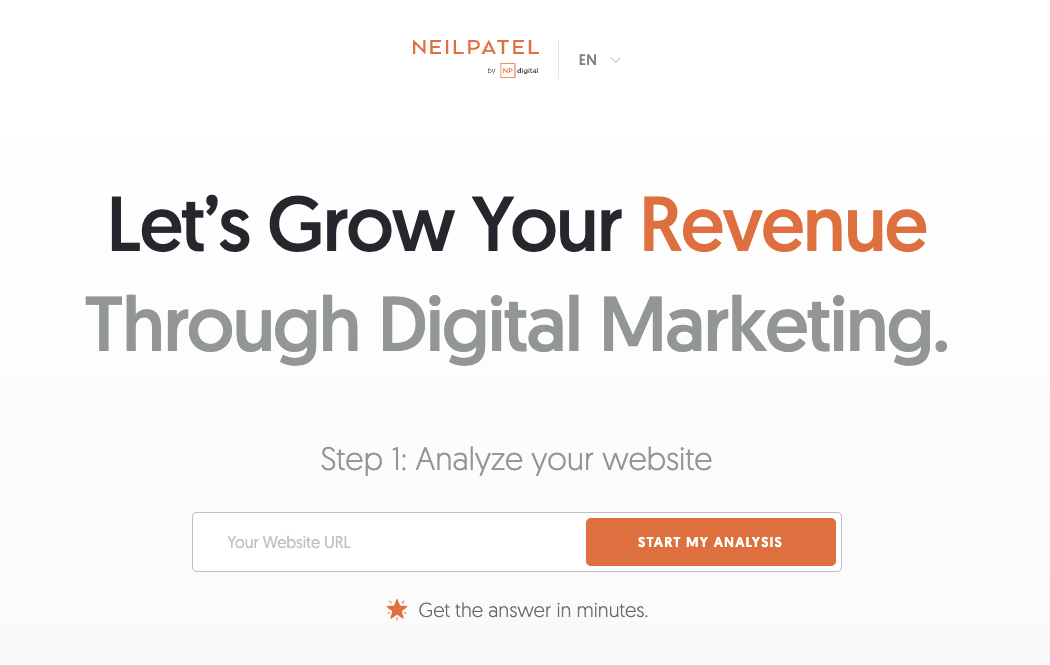
Neil Patel has mastered this approach through his free website analysis tool, which has become a cornerstone of his brand visibility. By offering instant SEO audits at no cost, he provides marketers and business owners with structured, actionable insights that are easy to understand and share. This tool not only attracts consistent traffic but also earns widespread citations from blogs, communities, and even AI-driven search systems, positioning his site as a trusted authority in digital marketing.
Publish buyer guides with explicit picks
Name your best overall, budget, and pro choices. Include test methods and scoring. Clear recommendations are often referenced in AI answers, which elevate your brand during consideration. A great example of this strategy is The Guardian’s buyer guides. Instead of presenting a long list, these articles names specific picks such as the best overall, the best budget, and the best pro model, while also explaining the testing process behind those choices. This structured, recommendation driven format makes it easy for both readers and AI search systems to pull clear answers and elevate the content during the consideration stage.

Offer transparent benchmarks
If your category permits it, run open benchmarks. Provide raw data and explain limitations. Trusted benchmarks become canonical references in AI summaries.
Case studies from brands moving first
Walmart
Walmart has explained how its generative AI search helps customers find products faster and make confident decisions, and how it is cleaning and enriching product data at scale. On earnings calls and in public notes, leaders described generative systems improving the quality and utility of the catalog for associates and shoppers. This is not theoretical. It is a wholesale modernisation of discovery that supports both conversion and customer service.
Sephora
Beauty shoppers rely on guidance, shade matching, and look building, which are ideal uses for AI. Public case studies describe Sephora’s virtual try on and recommendation engines boosting engagement and conversions. As AI answers look for trusted brand experiences to cite, interactive tools like these give models concrete outcomes to reference.

Perplexity as a demand channel
Perplexity has become a mainstream entry point for research style queries, backed by rapid user growth and significant funding, with the Financial Times reporting fifteen million monthly active users and large volumes of queries each month. If you publish expert content with clear citations, you can appear as a source in Perplexity’s answers and earn meaningful referral traffic.
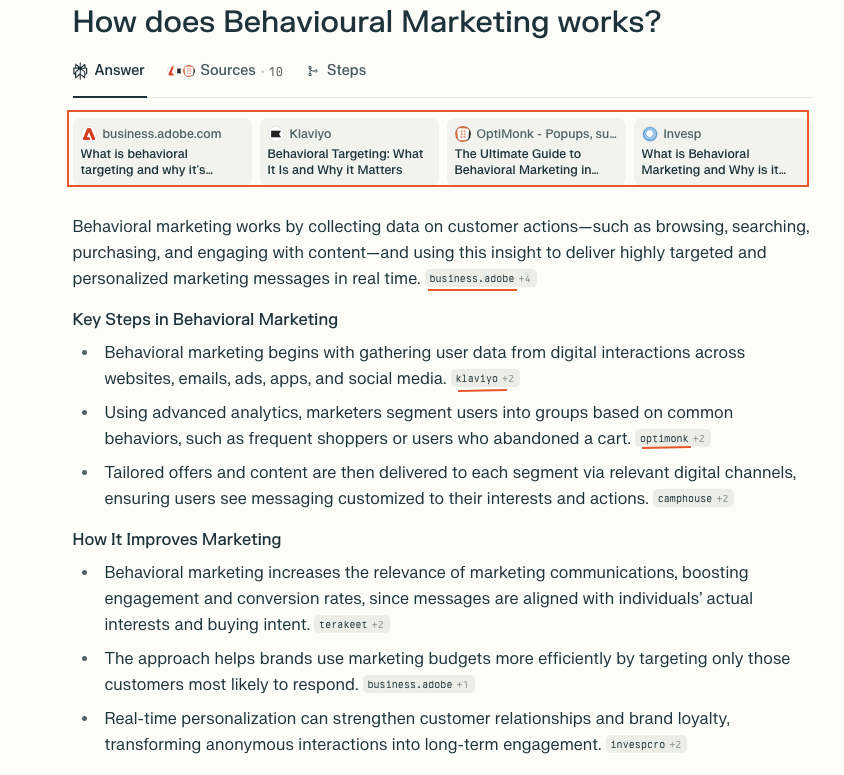
For instance, when searching “How Behavioural Marketing works,” the top results included Adobe, Klaviyo, and Optimonk. What these brands shared was not just authority, but precision — each provided a clear, direct answer to the query, supported by well structured explanations and formatting that made their content easy for Perplexity to extract and surface.
Build topical authority the way AI evaluates it
Topical authority now matters more than broad domain authority. You need depth, consistency, and expert signals across a focused set of themes.
Publish a topic map
List the ten to twenty subtopics that fully define your category. For each subtopic, plan one definitive hub page and three to five supporting resources. Ensure every page answers a specific user job to be done.
Consolidate and prune
Merge overlapping posts into a single stronger page. Redirect out of date content to the best current resource. Remove thin posts that confuse engines about your expertise.
Add expert bylines and review notes
Show the credentials of authors and reviewers. For regulated or sensitive advice, add a review stamp with the date. Clear expertise markers help engines select your content when building AI answers.
Capture feedback and citations
Encourage researchers, communities, and partners to link to your explainers and tools. When referring domains cite your specific claims, engines gain confidence that your content is correct.
Engineer retrieval for your own AI surfaces
Do not only optimise for other engines. Build AI search into your owned channels so you can convert intent directly.
Site search with semantic retrieval
Upgrade on site search to semantic retrieval with vector indexes that understand synonyms and intent. Include business logic to boost profitable items, inventory health, and customer satisfaction signals.
Product and content entities
Create a unified catalog of entities across products, articles, FAQs, and support docs. Use the same identifiers across systems. Your assistant or search tool should be able to retrieve an article and a product for the same intent.
Guardrails and provenance
Store citations and source metadata with every answer. Show users which page or policy the answer came from. This transparency is already a norm in Perplexity style engines and raises trust.
Feedback loops
Let users rate answers, flag gaps, and request new topics. Use this data to prioritise content updates and to tune retrieval weights.
Measure what matters in AI search
Clicks still matter, but they are no longer the only scoreboard. Add these metrics to your executive dashboard.
Inclusion rate in AI Overviews
Track how often your pages appear as cited sources for priority queries. Semrush’s study shows that inclusion correlates with perceived authority for that topic. Aim to raise inclusion within your target clusters month over month.
Share of cited sources by query class
For buying guides, how often are you one of the top three citations? For how to queries, how often does your HowTo page appear?
Assistant referrals and assisted conversions
Monitor referral volumes from AI assistants and engines. Similarweb reports rapid growth from AI platforms. Tie those visits to downstream conversion or qualified lead outcomes.
Coverage and freshness
Audit your topic map. What percent of subtopics have an up to date definitive page. What percent of your top answers were refreshed in the last quarter.
Experience signals
Track completion rates for calculators and interactive tools that AI engines might quote. These are proof points of utility and quality.
Align content with the jobs users hire AI to do
AI search often starts with a task, not a keyword. Write for the moment and the outcome.
Decision support
Publish side by side comparisons with clear pros and cons, explicit picks, and fit guidance for different user types.
Problem resolution
For troubleshooting, publish short step lists, common error codes, and expected outcomes. Add images that show what success looks like.
Planning and checklists
Create checklists for workflows such as vendor selection, legal compliance, or implementation. Models can easily summarise these and point users to your canonical version.
Education with pace
Offer quick start guides that teach the minimum required and link to deeper modules. Break large topics into levels so models can route beginners and experts appropriately.
Build for the marketplaces that already capture intent
Shoppers increasingly begin on marketplace or retailer search, not the open web. Treat these ecosystems like AI search engines in their own right.
Content parity
Ensure your Amazon, Walmart, or marketplace listings mirror your site content for specs, compatibility, and claims. Inconsistent details across channels reduce model confidence and lead to contradictory answers.
Rich media that answers questions
Upload explainer images, short videos, and comparison charts. These reduce returns and increase conversion while also providing assets that AI tools analyse.
First party reviews
Seed legitimate reviews that mention concrete use cases and outcomes. User language improves retrieval relevance and gives models real world phrasing to quote.
Data hygiene
Normalise titles, attributes, and units across all SKUs. Walmart’s push to clean hundreds of millions of product data points is a reminder that discovery quality is a data problem as much as a ranking problem.
Prepare leadership for the zero click economy
Executives need a clear narrative, because traditional dashboards can look worse even as influence grows.
Make three points with data.
First, zero click behaviour is now common. Nearly 60% of searches in 2024 ended without a click, and AI Overviews now appear in more than one in eight searches.
Second, discovery is fragmenting. About half of product journeys start on Amazon, and AI platforms are sending many more referrals than a year ago even if they do not fully replace classic search traffic yet.
Third, brands that invest in structured content, clean data, and on site AI see measurable efficiency and conversion gains, as Walmart’s public disclosures and case notes indicate.
A twelve week plan to start dominating AI search
.png)
Common mistakes to avoid
- Publishing long essays with no direct answer: AI systems prefer concise, verifiable statements. Put the answer first.
- Creating scattered posts that cannibalise each other: Consolidate into definitive hubs with clear spoke pages.
- Ignoring data quality: If your specs and attributes conflict across pages and channels, models will down rank or skip your content.
- Relying only on backlinks: Backlinks still matter, but topical coverage, clarity, and structure often decide whether you appear inside AI answers.
- Measuring only clicks: Track citation share, assistant referrals, and completion of on site tools. These reflect real influence in AI search.
The bottom line
AI has moved discovery from lists to answers. To dominate, publish definitive and structured content, maintain impeccable product and policy data, and build your own intelligent search that converts intent on site. Brands already applying these principles are winning visibility and market share in a world where many searches never produce a click. If you become the clearest source and the easiest path to action, AI systems will repeatedly choose you, and customers will follow.
Dive into our latest blog: The Role of E-E-A-T in the Age of AI Search


Adxom is a global SEO and link-building platform
trusted by startups, agencies, and brands to grow
rankings with fast, reliable, hassle-free results.
