How ChatGPT, Perplexity & Google AI Evaluate Backlinks
 - 2026-05-15T103621.821.jpg)
Search has fundamentally changed.
For two decades, SEO was primarily about ranking webpages in Google’s traditional results. Backlinks acted as votes of confidence that influenced PageRank and organic visibility.
Today, AI search systems such as ChatGPT Search, Perplexity, and Google AI Overviews operate differently. These systems are no longer just ranking pages. They are synthesising answers, selecting citations, and deciding which sources deserve inclusion inside generated responses.
That shift changes the role of backlinks completely.
Backlinks are no longer just ranking signals. They are now trust validation signals that help AI systems determine whether your content is authoritative enough to cite.
In other words:
Traditional SEO focused on rankings.
AI search focuses on references.
This distinction matters because AI systems are designed to minimise hallucinations and increase confidence in generated answers. One of the strongest ways they estimate credibility is by analyzing the authority ecosystem surrounding a piece of content.
That ecosystem includes backlinks, brand mentions, author reputation, entity relationships, citation consistency, and topical depth.
Why Backlinks Matter More in AI Search
Large language models do not “think” like search engines.
However, modern AI search systems still rely heavily on signals originating from the web’s link graph.
Why?
Because backlinks remain one of the clearest indicators of digital trust.
When authoritative publications consistently reference a domain, it signals several things:
- The brand is recognised within its niche
- Other experts trust the information
- The content has demonstrated value externally
- The site has accumulated topical authority over time
AI systems use these patterns to determine citation confidence.
A strong backlink profile increases the likelihood that your content is:
- Retrieved during AI search
- Considered authoritative enough to cite
- Used as supporting evidence in generated summaries
- Mentioned repeatedly across prompts
Recent AI visibility research found that citation overlap between platforms is surprisingly low. Only around 11% of cited domains appear consistently across ChatGPT and Perplexity results.
.jpg)
This means visibility in one AI platform does not guarantee visibility in another. Each system evaluates authority differently.
How ChatGPT Evaluates Backlink Authority
ChatGPT’s search functionality combines retrieval systems, web indexing, and language generation.
Unlike Google, ChatGPT is not displaying ten ranked blue links. Instead, it attempts to synthesise the most reliable answer from multiple sources.
That changes how backlink authority is interpreted.
1. ChatGPT Prioritises Entity Authority
ChatGPT appears to rely heavily on broader entity recognition rather than raw backlink quantity.
For example, a website repeatedly referenced by:
- Major news publishers
- Academic resources
- Industry blogs
- Wikipedia
- Government websites
is more likely to become part of the model’s trusted knowledge ecosystem.
Research into ChatGPT citation behaviour found that institutional authority strongly influences cited sources.
This explains why websites such as Mayo Clinic, Investopedia, HubSpot, NerdWallet, and Wikipedia are frequently surfaced in AI answers.
These brands possess:
- Strong backlink ecosystems
- Established topical authority
- High citation consistency across the web
2. Link Quality Matters More Than Volume
In AI search, 1 backlink from Harvard or Forbes may outweigh hundreds of low quality directory links.
ChatGPT appears to prioritise:
- Editorial backlinks
- Contextual citations
- Expert references
- Consistent mentions from trusted entities
Spammy link building patterns can actually weaken trust signals because AI systems increasingly evaluate source credibility holistically.
3. Brand Mentions Reinforce Backlinks
AI systems are increasingly entity based rather than keyword based.
That means linked mentions and unlinked mentions both matter.
If authoritative websites consistently discuss your brand alongside a topic, ChatGPT may associate your domain with expertise in that category.
For example:
If dozens of marketing publications reference a SaaS company in discussions about AI SEO, the model begins reinforcing semantic authority connections around that brand.
This is why digital PR has become critical for AI search visibility.
How Perplexity Evaluates Backlink Authority
Perplexity functions more like an AI powered answer engine layered on top of web retrieval.
Unlike ChatGPT, Perplexity aggressively cites sources directly inside responses.
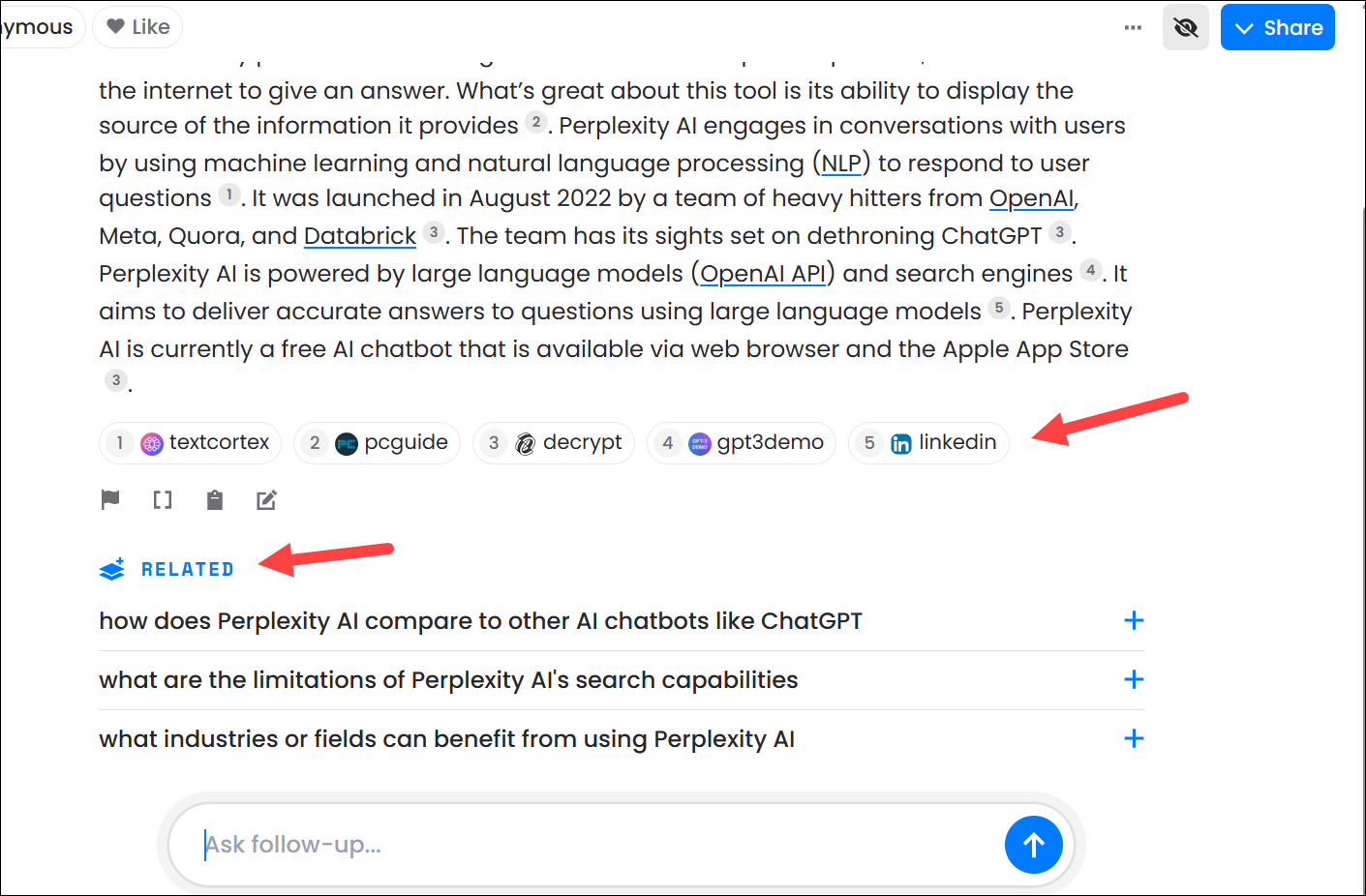
This makes backlink authority even more important.
1. Perplexity Strongly Rewards Citation Worthiness
Perplexity tends to favor content that already appears authoritative from a search perspective.
That includes pages with:
- Strong backlink profiles
- High topical relevance
- Fresh updates
- Clear structure
- Question based formatting
Research comparing AI citation systems found that Perplexity heavily favours sources with strong metadata, semantic structure, and authority indicators.
2. Perplexity Prefers Structured Authority
Pages with backlinks from recognised industry domains appear more likely to receive citations.
For example:
A cybersecurity article linked by:
- Gartner
- TechCrunch
- Cloudflare
- CISA
has stronger AI citation potential than a similar article with weak affiliate backlinks.
Perplexity appears particularly sensitive to:
- Expertise consistency
- Topic specialisation
- Cross source validation
3. Fresh Backlinks Influence Recency Trust
Perplexity heavily values freshness.
If your content continues attracting recent backlinks and mentions, the system may interpret this as ongoing relevance.
That is critical because AI systems increasingly prioritise:
- Updated statistics
- Current examples
- Recent discussions
- Active authority signals
Static content without fresh references gradually loses citation momentum.
How Google AI Overviews Evaluate Backlink Authority
Google AI Overviews differ from ChatGPT and Perplexity because they are deeply integrated into Google’s existing ranking infrastructure.
This means traditional SEO signals still matter significantly.
However, Google AI Overviews add another layer: generative synthesis.
1. Google Uses Existing Search Authority Signals
Google’s AI systems still rely heavily on:
- PageRank
- Link authority
- Domain trust
- E-E-A-T signals
- Content relevance
If your content struggles to rank organically, it is unlikely to appear consistently inside AI Overviews.
This creates a major advantage for websites with mature SEO foundations.
2. Google Evaluates Link Relevance Contextually
Topical relevance matters more than generic authority.
For example:
A backlink from Search Engine Journal carries more AI SEO relevance than a backlink from a random high authority entertainment website.
Google increasingly evaluates:
- Topical proximity
- Semantic relationships
- Subject expertise
This means niche authority often outperforms broad authority.
3. Google Cross Validates Information
Google AI Overviews appear to favour information repeated consistently across trusted sources.
That means backlinks indirectly strengthen visibility by helping content spread across the web ecosystem.
If many authoritative sites reference similar statistics or cite the same research source, Google gains higher confidence in surfacing that information.
This is one reason original research performs exceptionally well in AI search.
Why Original Research Earns More AI Citations
AI systems love first hand sources.
Original surveys, case studies, datasets, and industry reports naturally attract backlinks.
But they also increase citation probability because they provide unique information AI systems cannot easily find elsewhere.
For example:
A SaaS company publishing:
- Annual benchmark reports
- Proprietary datasets
- Industry surveys
- Experiment results
creates assets that journalists, bloggers, analysts, and AI systems repeatedly reference.
This compounds authority over time.
The strongest AI citation assets are usually:
- Highly referenced
- Statistically rich
- Frequently updated
- Widely discussed
The Shift From Link Building to Authority Engineering
Traditional link building focused heavily on acquiring backlinks at scale.
AI search changes the objective.
The real goal now is authority engineering.
That means building a digital footprint that AI systems interpret as trustworthy, expert, and consistently referenced.
The brands winning AI search typically combine:
- High authority backlinks
- Strong entity recognition
- Expert authored content
- Structured schema markup
- Topical clusters
- Fresh updates
- Original research
- Consistent digital PR
This creates an authority flywheel.
Backlinks amplify citations.
Citations amplify visibility.
Visibility amplifies mentions.
Mentions attract more backlinks.
What Businesses Should Do Next
If you want stronger visibility inside ChatGPT, Perplexity, and Google AI Overviews, your backlink strategy must evolve.
Focus on:
Earn Editorial Links
Prioritise:
- Industry publications
- News sites
- Expert roundups
- Research citations
- Podcast mentions
Avoid low quality link schemes.
Build Topic Clusters
AI systems reward depth.
Instead of isolated articles, build interconnected topical ecosystems covering an entire subject comprehensively.
Publish Original Data
Data driven content earns:
- Natural backlinks
- Press coverage
- AI citations
- Brand mentions
This is one of the highest leverage AI SEO strategies today.
Improve Entity Authority
Strengthen author identity, brand consistency, and external references.
AI systems increasingly evaluate who is speaking, not just what is written.
Update Content Frequently
Freshness is now a major citation signal.
Update:
- Statistics
- Screenshots
- Case studies
- Examples
- References
Regular updates reinforce authority and relevance.
Final Thoughts
Backlinks are not disappearing in the AI era.
They are becoming more important.
But their role is evolving.
AI search systems do not simply count links. They interpret them as signals of credibility, expertise, relevance, and trustworthiness.
ChatGPT evaluates entity authority and contextual trust.
Perplexity emphasises citation readiness and structured credibility.
Google AI Overviews combine traditional PageRank signals with AI driven synthesis and semantic validation.
The common denominator across all three systems is authority.
And backlinks remain one of the clearest ways AI systems measure it.
The future of SEO is not just about ranking pages.
It is about becoming the source AI systems trust enough to cite.


Adxom is a global SEO and link-building platform
trusted by startups, agencies, and brands to grow
rankings with fast, reliable, hassle-free results.
